
A name you would say out loud
If you would be embarrassed to put it on a business card, no metric rescues it.

Expired Domain Hunter
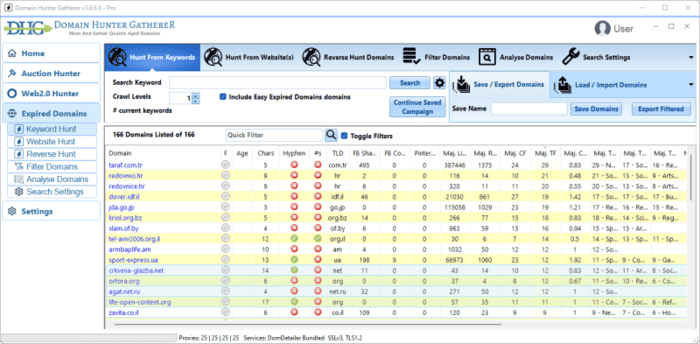
Use Domain Hunter Gatherer for Windows to discover expired domains through keywords, website crawls and backlink paths. Check availability, compare the evidence and export your shortlist with Premium or Pro.
Four ways in
There is no single correct way to begin. Start from what you know, and let the software do the legwork from there.
You know the subject. You just need the names.
Give DHG the words your audience searches for. It looks for expired names connected to that subject, ready for you to compare and filter. Keyword discovery is included in Premium and Pro.
Good sites link to other good sites. Some of those have expired.
Point DHG at an authority site, a resource page or a competitor. It then crawls the site looking for outbound links, checking the availability of all unique domains found, which is how it finds names that never appear on a public drop list.
Five spreadsheets, no way to compare them.
Import domain lists that you have and automatically check all for availability. Then you can easily analyse them and filter and sort to bring the best domains to the top of the list.
The tactic everyone overlooks
Start with a competitor website and explore backlink paths to find additional domain candidates. Check each candidate for availability, relevant history and link quality before deciding whether it fits your project.
See it properly
Watch a real session: picking a seed site worth crawling, letting it run, then cutting several thousand results down to the handful actually worth opening in a browser.
Watch on YouTubeThis is a real campaign
You set it going, you go to bed, and it keeps working. This is a genuine readout from one campaign seeded with a single well-connected website. Press play and watch roughly forty seconds of it.
An illustration of the software using figures from one real campaign. Nothing is being crawled from this page.
Waiting for the first find…
Names shown are genuine results from this campaign at the moment it was captured. Availability changes constantly — always check before you plan around a name.
Why the numbers get small
With DHG, finding domains is the easy part. Most are already taken, and a majority of the rest are not worth having. The work is in the narrowing the list down, which is the part DHG does for you.
That last number is where your judgement starts. DHG gets you to a shortlist; deciding which names deserve your money is still a human job, luckily DHG also helps with this.
Before you reach for your card
Four questions worth asking about every name that survives your filters.
If you would be embarrassed to put it on a business card, no metric rescues it.
Inspect the pages behind the numbers. Relevant editorial references are more useful evidence than a large unexplained link count.
Check the archive. A domain with an awkward past can be more trouble than it is worth.
Metrics point you at candidates. They do not make the decision for you.
Then what?
Put a proper content site on a name that already fits the topic and has a credible past.
A carefully matched redirect, where the old subject and the new destination genuinely line up.
Brandable and commercially useful names have a habit of being worth more later than they cost today.
Chosen deliberately, after you have looked at quality, relevance and historical risk.
When finding them is not enough
Discovery is the first half. Pro adds the tools for the second: richer quality context on the names you like, a prepared search for when you want results now, and archive recovery for when you are ready to build.
Reasonable questions
Straight answers, including the ones that are less flattering than a sales page would normally allow.
A domain name that somebody stopped paying for. When a registration lapses and is not renewed, the domain eventually returns to the pool and anyone can register it. Some carry years of links and recognition. Plenty carry nothing at all, which is exactly why the research matters.
There is no guaranteed ranking benefit. Previous links and age do not establish the value of a domain by themselves. Review its history, relevance and link quality, then judge whether it is a suitable home for the content or service you intend to build.
As long as you let it. We ran a campaign (for a video) and it crawled over 24 million pages and was 3% through its total workload. You can stop at any point, export what has been found so far, and pick it up later. Visit the Video Guides section and see the "90k domains" video for how this went.
The keyword, niche and authority-crawling tools are in the current Premium and Pro plans. Pro adds DomDetailer credits, Easy Expired Domains and DomRecovery for the extra research that comes after the find.
Yes. Import it and it goes through the same checks and filters as anything DHG finds itself, which is the only way to compare candidates from different sources fairly.
Go and have a look
Pick a plan, point it at a site you rate, and see what it drags back.
Plan your first search
Follow our step-by-step guide to finding expired domains to choose a search method and review the results. If you are comparing previously used names, the beginner's guide to aged domains explains the history and quality checks to make before registration.
Already have a shortlist? Compare registration options in the domain registrar directory.
DHG Premium costs $27 per month or $247 per year, billed in US dollars.
DHG Pro costs $97 per month or $679 per year, billed in US dollars. These are suite subscription prices; the feature is included with the relevant plan.
Compare plan features, billing options and the Pro Lifetime licence before choosing.
Set the scope of a hunt with our practical guide to choosing DHG crawl levels.
For a focused search, use our walkthrough for finding forgotten domains in your niche.
Choose useful crawl starting points with our guide to researching domains linked by competitors.
Before registering a candidate, follow our steps for checking domain history and link quality.